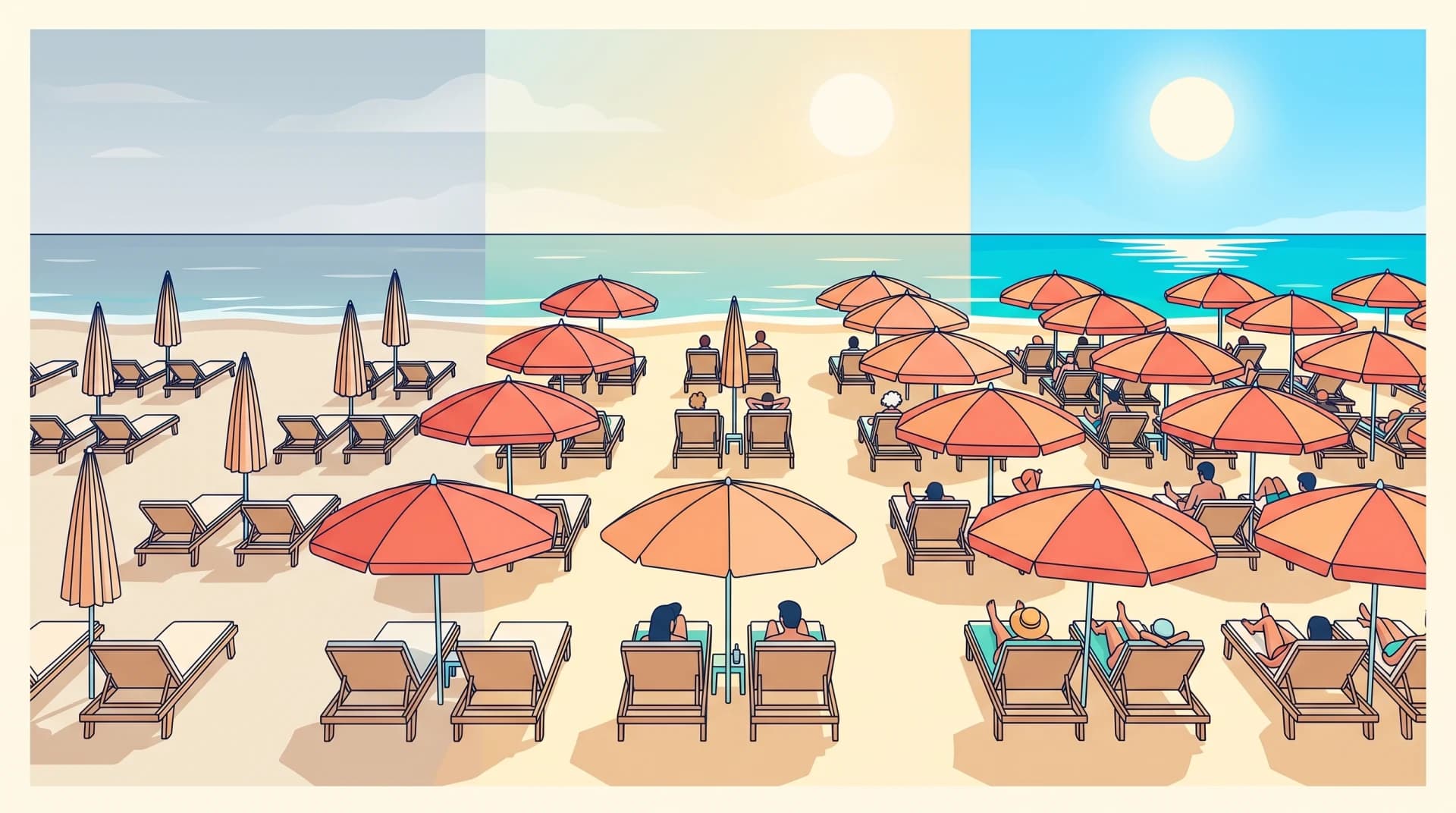
A hundred sunbed bookings in one sitting: how a beach attendant really works

You've got one attendant who never puts the phone down: he seats a guest and, right there, marks the sunbed, charges it if it's due, and moves on. And you've got another, over in the back row, who works the way he always has —seat, charge, keep it all in his head— and mid-morning, when the trickle of people eases off, he sits down for five minutes and enters all forty bookings at once. Both get it right. By closing time, your beach map is just as tidy with one as with the other.
That's the idea that's hardest to believe and the most reassuring: a good system doesn't come to change the way you work, it comes to capture it. It makes no difference whether you'd rather log each booking on the fly or enter them all in one quiet spell. Getting a hundred bookings in with their status takes minutes, and you do it right there on the sand, phone in hand.
Two ways of working, the same result
There's no single right way to run a sunbed zone, and anyone who's spent a summer on the sand knows it. There are Saturdays when you don't have a spare second to pull out your phone between guests, and slow days when marking each booking on the spot feels natural. The mistake almost every tool makes is forcing you to pick one way and punishing you the moment you step off-script.
Not here. The one who moves fast marks in real time; the one who's swamped does it later, when he can. And since each booking goes in with two taps —one sunbed, one status— catching up isn't a chore, it's a five-minute breather. Forty spots, a hundred, however many your zone holds: they go in just as fast.
Four statuses, one tap for each
The whole operation fits into four words your team gets without a manual: booked, paid, check-in, and released. Every sunbed on the map wears them as a color, so at a glance you know how your zone is doing without asking anyone.
And to move from one to the next, one big button and done. You tap the sunbed, pick what's happened, and the map updates instantly for everyone. No menus, no long forms: on the sand, hands full and sun in your face, what works is a gesture, not a screen full of options.
Charge now or when they arrive (or both)
Payment and arrival are two different things, and it pays to keep that clear. A booking can be paid with the guest still nowhere in sight: that's normal when someone books and pays online the night before. The spot is theirs, and paid, even if the sunbed is still empty at ten in the morning.
And the other way around: when the guest shows up, your attendant checks them in, which marks their arrival and counts the booking as paid in the same move. If it already came paid from home, it isn't charged twice —it just logs that they've arrived—. For whoever's on the sand it's a single motion; for you, one less spot to keep an eye on.
Release a spot without losing it
A booked sunbed that goes empty at midday is money standing still. That's why releasing a spot isn't just deleting it: your attendant says why it's freed up —the guest left, was a no-show, canceled it— and that reason is logged in case you need to look into it later.
The best part comes next: the moment the spot is free, if someone was waiting their turn, the waitlist notifies the next person on its own. The sunbed you were about to lose is back in play without anyone lifting a finger.
The last-minute curveballs
The beach is unpredictable, and the system has to handle the plot twists. A guest doesn't like their spot and you want to move them to another sunbed? The booking moves to the new spot without redoing a thing: it travels with its payment and its details, and the old one frees up right away.
A family of six shows up wanting their sunbeds together? You don't go one by one: you charge or release the whole group at once, with a single tap. What's a moment of stress on the sand is ten seconds on the phone.
Everyone sees their own; you see it all
Your attendants taking bookings and charging doesn't mean they see the books. Each one handles their own: their zone, their bookings, and the prices they need to charge correctly. The day's totals and the takings are yours and no one else's.
That boundary is what lets you delegate with peace of mind. Your team has on their phone exactly what they need to work; and you, wherever you are, see the full picture and balance the till at closing without chasing anyone.
At your own pace, without losing a thing
In the end it's not about working a different way, but about the way you already work leaving a trace. Live or all at once, sunbed by sunbed or a hundred at a time, it all ends up in the same place: a tidy map you can check whenever you like.
Take a look at the plans and how it fits your business. The season already brings enough hustle without you, on top of it, wrestling the very tool that's meant to take it off your hands.