Balancing the till at your beach bar when several people take payment and it's almost all cash
How many times have you closed out the cash with the nagging feeling that some is missing and no way of knowing where it went? If you take payment almost entirely in cash and have several people charging customers across different zones, that shortfall at closing isn't bad luck: it's what happens when money passes through many hands and the only ledger is your memory.
Cash leaves no trail, and when several people are charging in several places, that trail is exactly what you're missing at closing time. The way out isn't to give up on cash —it's to make every payment leave a mark the moment it happens.
Why the cash comes up short when several people take payment
The problem isn't your team or the cash itself. It's that the information ends up scattered: what your VIP-zone attendant charged is in their head and their money belt; what the front-row attendant took is in theirs. At the end of the day you pool the money, but not the decisions —who gave out which sunbed, at what price, whether they charged for it or left it "for later"—.
With two zones and a quiet day, you can keep it in your head. With three zones and a hundred-odd sunbeds on a Saturday in August, no memory or notebook can keep up. Every gap between what got booked and what landed in the drawer is a place where money slips away without you noticing.
Mark every payment the instant it happens
The piece that changes everything is telling apart two things that look the same but aren't: a sunbed being occupied and a sunbed being paid for.
Occupied means someone's on it: your attendant has checked them in. Paid for means it's been settled. The two don't always go together —a spot can be booked and unpaid, or paid in advance and still empty—, and mixing them up is behind half of every "I thought that one was already paid for".
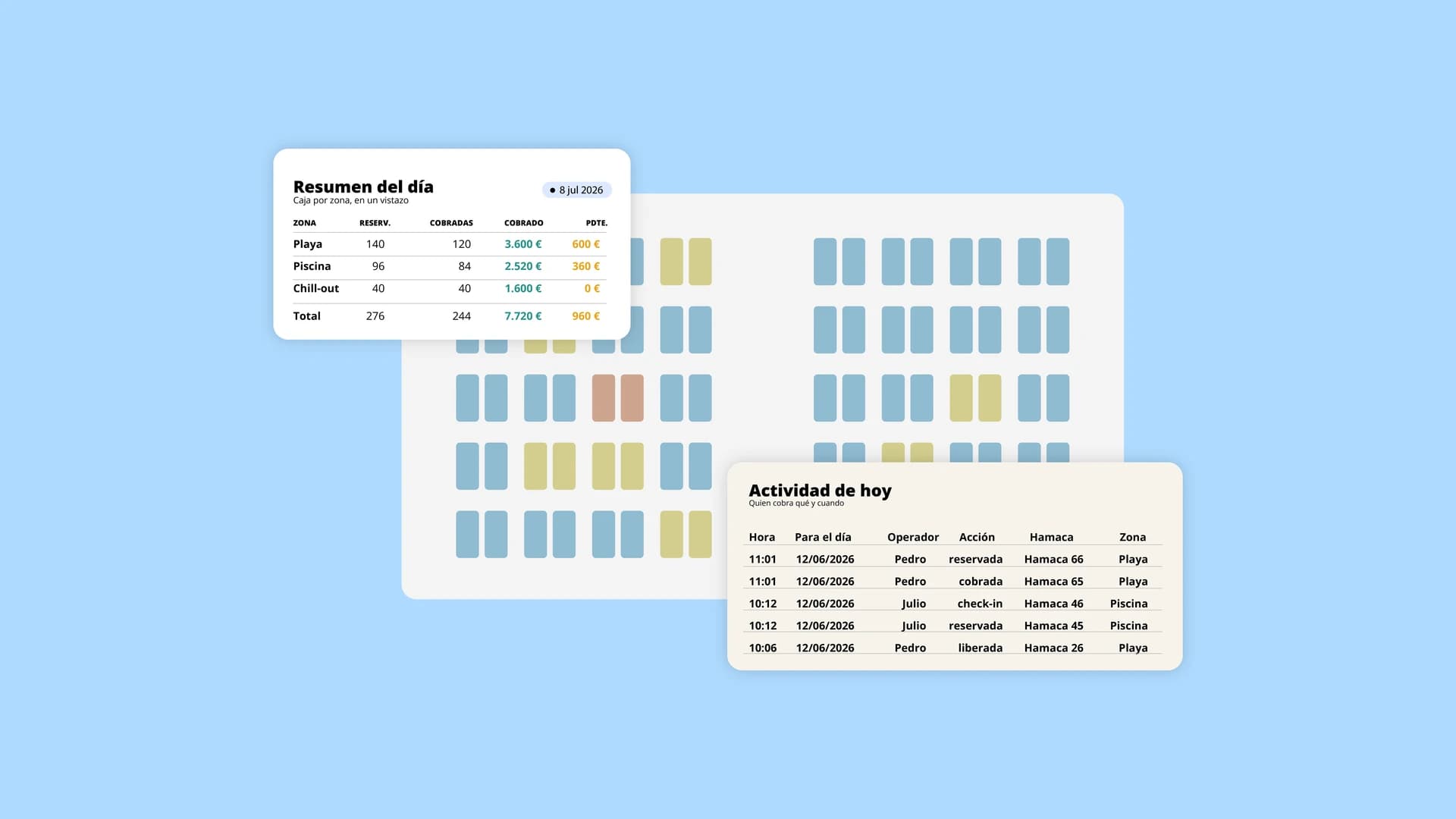
On the sunbed map, every spot shows where it stands. When your attendant takes payment for one, they mark it as paid from their own phone with a single tap, and it's flagged as settled right away. If no one in your business sits down without paying, the check-in itself counts as payment: seating the customer and charging them are a single gesture. Either way, the payment is logged with its timestamp —and, if you want, with a receipt or invoice for the customer—, without a single entry by hand.
Closing the day, zone by zone
This is where the cash drawer stops being a mystery. The daily summary shows you, without adding up a thing, what happened in each zone: how many sunbeds were booked, how many are paid for and for how much, and how many are still unpaid. One row per zone and a total at the bottom.
Since each attendant runs their own zone, that breakdown by zone tells you at a glance how much came in at each post. If the front-row drawer is a hundred euros short of what its zone says it should be, you no longer close up on a vague hunch: you have the exact figure and you know where to look. And if you need it for your accountant, you take it away on a single sheet —exported or printed— with nothing to copy out clean.
When a figure doesn't add up: the activity log
The summary tells you how much is missing; the activity log tells you what happened. Every payment, every sunbed that was freed up, every change is recorded with its timestamp. You can read it in order or grouped by sunbed, to follow the trail of one particular spot through the day.
That way, a discrepancy stops being "I charged for that one" versus "I never gave it out" and becomes a ten-second lookup. It's not about keeping an eye on anyone: it's about letting honest slip-ups —a sunbed handed out in a rush and never marked— come to light and get fixed, instead of eating into your margin in silence.
Everyone sees only what's theirs
Your attendants taking payment doesn't mean they see the business's books. Each one handles their own patch: their zone, their bookings and the price of each sunbed, which they need in order to charge correctly. The totals, the day's takings and the revenue are your business and no one else's.
That boundary is what lets you delegate payment with peace of mind. Your team has on their phone exactly what they need to work, not one detail more; and the full picture of what's coming in —the one you actually care about balancing— stays with you alone. You look at it whenever you like, from your phone without setting foot on the sand.
Closing the day at a glance
Balancing the till shouldn't be a nightly exam. With every payment marked the instant it happens, the day's takings summed up by zone and a log to go back to whenever a figure doesn't fit, closing goes from half an hour of sweating to a quick glance.
You keep charging the way you do today —in cash, by card reader, online or all three at once—; the only thing that changes is that now everything leaves a trail. Take a look at the plans and at how it fits your beach bar: the season is demanding enough without losing money in the count on top of it.